Choosing among corn grinders for small businesses means balancing throughput, grind consistency, power requirements, cleanup, and available workspace. The right mill can support food production, animal-feed preparation, or small-batch processing without overspending on unnecessary capacity.
This roundup compares 10 selected grinders across electric and manual designs, hopper sizes, output ranges, grind adjustment, and intended use. Use the guide below to narrow your options based on workload, budget, and operating environment.
Best 10 Corn Grinders for Small Businesses Picks for 2026
Most Versatile Commercial Pick
VEVOR 3000W Wet & Dry Corn Mill

- 3000W motor for continuous grinding
- Dry and wet milling discs included
- Adjustable thickness with durable cast-iron body
Best For: Small food businesses processing dry grains and soaked ingredients
Best Manual Workhorse
Victoria 2400g Cast Iron Grain Mill

- Manual design needs no electricity
- 2400g high-hopper capacity
- Clamps to tables with adjustable grind
Best For: Modest batches and power-independent milling
Best Dry-Grinding Value
VEVOR 3000W Commercial Corn Mill

- 3000W electric motor for dry grinding
- Adjustable settings for multiple crops
- Durable cast-iron plates and funnel feed
Best For: Repeat dry-grinding batches with 500 g loading capacity
Best Simple Manual Option
XXL 7.5 lb Cast Iron Grain Mill

- Heavy-duty cast-iron manual design
- Handles corn, wheat, oats, and brewing grains
- Includes crank, hopper, body, and clamp
Best For: Modest workloads needing a basic non-electric mill
Fast Countertop Milling
VEVOR 1.8-Lb Electric Grain Mill

- 2,100W, 28,000-RPM motor for fast dry grinding
- 30–300 mesh adjustment with timed controls
- Compact 1.8-lb capacity for smaller batches
Best For: Small commercial kitchens and dry ingredient preparation
Heavy-Duty Corn Processing
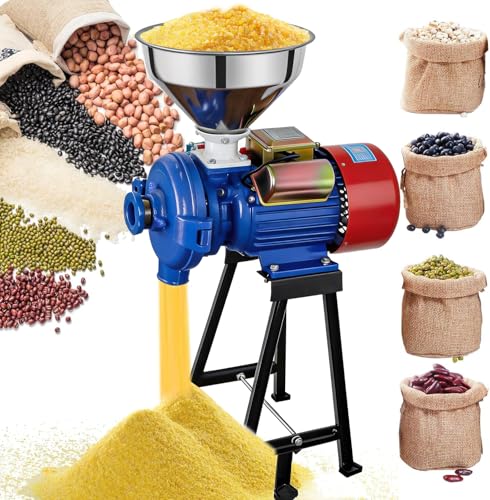
- 3,000W copper motor for powerful dry grinding
- Large stainless-steel hopper reduces refill frequency
- Adjustable thickness from coarse to ultra-fine
Best For: Small farms and demanding dry-grain or feed preparation
High-Capacity Feed Milling
60L Electric Corn Grinder with 7 Sieves

- 60L hopper supports fewer refills during processing
- Seven sieves customize feed and flour texture
- Handles dry corn, grains, and livestock-feed ingredients
Best For: Farms and small feed operations with recurring grain workloads
High-Capacity Pick
FoundGo 6.6-Gallon Electric Grain Grinder

- 6.6-gallon hopper for larger batches
- Five sieve sizes from 2 to 8 mm
- 1,000W motor with overheat protection
Best For: Small farms and moderate-batch feed preparation
Heavy-Duty Power Pick
3000W Adjustable Commercial Grain Grinder

- Rated capacity of up to 200 pounds per hour
- Adjustable coarse-to-fine grinding
- Corrosion-resistant galvanized cast iron housing
Best For: Higher-volume grain, feed, and flour processing
Portable Value Pick

- 25-liter capacity for routine batches
- Five interchangeable sieves
- Detachable parts support easier cleaning
Best For: Lower-volume farms and portable grinding tasks
Most Versatile Commercial Pick – VEVOR 3000W Wet & Dry Corn Mill
For small businesses needing flexible corn grinders for small businesses, this VEVOR model combines high-powered electric grinding with both dry and wet milling. Its adjustable thickness control, stainless-steel funnel, and cast-iron construction suit recurring food-preparation or feed-grinding work.
Best For: Small food businesses that need to process dry grains as well as soaked soybeans or rice.
Pros:
- 3000W motor supports continuous, high-speed grinding.
- Includes cast-iron and sand milling discs for dry and wet grinding.
- Adjustable texture works for corn, grains, spices, coffee, and nuts.
- Solid cast-iron body and stainless-steel funnel are built for frequent use.
Cons:
- Its 19.88-by-9.84-by-27.56-inch industrial format requires dedicated space.
- Heavier-duty construction may be more machine than occasional users need.
This is the strongest all-around option in the group when a business needs more than dry corn flour. The wet-grinding capability expands its usefulness for tofu, soy milk, rice cakes, and related food production.
Best Manual Workhorse – Victoria 2400g Cast Iron Grain Mill
The Victoria is a practical manual choice among corn grinders for small businesses that value simple operation and independence from electricity. Its clamp-on design, high hopper, adjustable screw, and sturdy cast-iron build make it suitable for modest batches and hands-on preparation.
Best For: Small operations, market vendors, and brewers handling manageable batches without electric power.
Pros:
- Heavy-duty cast-iron construction with double tin plating.
- High hopper holds up to 2400 g.
- Adjustable screw changes the coarseness or fineness of the grind.
- Clamp fits tables 1/2 to 2 inches thick and includes a non-slip protector.
Cons:
- Manual cranking is slower and more labor-intensive than electric milling.
- It cannot produce a superfine texture or fine whole-wheat powder.
- Its listed warranty is a 90-day limited warranty.
Choose this mill when control, portability around a worktable, and low mechanical complexity matter more than throughput. Its texture limitation makes it less suitable for businesses that require consistently superfine flour.
Best Dry-Grinding Value – VEVOR 3000W Commercial Corn Mill
This VEVOR model is a focused electric option for businesses comparing corn grinders for small businesses that primarily need dry milling. It pairs a 3000W motor with cast-iron grinding plates, adjustable thickness, and a steady funnel feed for grain and crop processing.
Best For: Small businesses producing dry cornmeal, grain flour, or powdered ingredients in repeat batches.
Pros:
- Powerful 3000W, 110V electric motor supports high-speed grinding.
- Cast-iron plates are described as durable and easy to clean.
- Adjustable setting accommodates corn, wheat, rice, sorghum, spices, and nuts.
- Funnel-shaped feed design promotes consistent feeding.
Cons:
- It is a large, heavy machine at 46.7 pounds.
- The listed capacity is 500 g, so users may need repeated loading for larger batches.
- This version is specified for dry grinding rather than wet milling.
For dry products, this offers a straightforward commercial-style setup without the added wet-grinding accessories of the other VEVOR model. Confirm that the 500 g capacity fits your batch workflow before buying.
Best Simple Manual Option – XXL 7.5 lb Cast Iron Grain Mill
This XXL manual mill is a compact, no-frills candidate among corn grinders for small businesses. Its hand crank, cast-iron body, hopper, and table clamp are suited to businesses that want a basic setup for corn, wheat, oats, and brewing grains.
Best For: Small-scale milling where a manual grinder and straightforward cast-iron construction are sufficient.
Pros:
- Heavy-duty cast-iron construction.
- Manual operation avoids dependence on electricity.
- Designed for corn, wheat, oats, and brewing grains.
- Includes a crank, hopper, body, and table clamp.
Cons:
- The supplied notes provide limited information about grind adjustment and texture.
- Manual operation may not suit high-volume commercial production.
- At 7.5 pounds, it is sturdy but still requires physical effort to operate.
This is best treated as a basic, hands-on mill for modest workloads rather than a high-throughput production machine. Its appeal is simplicity, but buyers should verify the desired grind range and clamping setup before committing.
Fast Countertop Milling – VEVOR 1.8-Lb Electric Grain Mill
For small businesses seeking corn grinders for small businesses that can also handle spices, coffee, and other dry ingredients, this VEVOR model combines a 2,100W motor with a compact 1.8-pound capacity. Its timed controls and adjustable fineness make it practical for short, repeatable batches.
Best For: Small commercial kitchens, spice preparation, and dry corn or grain batches where compact size matters.
Pros:
- 28,000-RPM motor and triple stainless-steel blades can produce fine powder quickly.
- Adjustable grinding from 30 to 300 mesh with 5-, 15-, and 30-second timer settings.
- Simple four-step operation and cleaning with a damp cloth or brush.
Cons:
- Limited to a 1.8-pound capacity, so larger orders require multiple batches.
- Designed for dry materials only; wet, oily, and sticky ingredients are unsuitable.
- Requires rest periods after up to five minutes of continuous operation.
This is a flexible choice when your business needs finely ground dry corn alongside other ingredients, but its smaller chamber makes it better suited to batch work than high-volume production.
Heavy-Duty Corn Processing – 3000W Electric Grain Mill
Businesses comparing corn grinders for small businesses may prefer this heavy-duty electric mill when speed, sturdy construction, and adjustable output are priorities. Its 3,000W copper motor is designed for dry corn and other crops, while the enlarged hopper supports a smoother workflow.
Best For: Small farms, feed preparation, and businesses processing dry corn, wheat, rice, sorghum, or similar grains.
Pros:
- 3,000W commercial-grade copper motor provides powerful dry-grinding performance.
- Adjustable thickness knob allows coarse-to-fine processing.
- Large stainless-steel hopper supports continuous feeding with fewer refills.
- Galvanized body and cast-iron head are built for heavy-duty use.
Cons:
- Strictly for dry grinding; soaked or wet ingredients should not be used.
- Must be started before gradually adding grain to help prevent jams or motor overload.
- Its heavy-duty construction may be more machine than low-volume users need.
With its powerful motor and robust build, this mill is a strong fit for demanding dry-grain work. Follow the startup and feeding instructions carefully, especially when adjusting from coarse to fine.
High-Capacity Feed Milling – 60L Electric Corn Grinder with 7 Sieves
For small farms and feed-focused operations, this 60-liter electric mill stands out among corn grinders for small businesses by reducing refill time and offering seven sieve options. It is designed for dry corn and other grains used in poultry, livestock, and general feed preparation.
Best For: Farms, homesteads, and small feed operations that need high-capacity grain processing with selectable particle sizes.
Pros:
- Large 60L (15.8-gallon) hopper supports longer runs between refills.
- Seven interchangeable sieves provide control over feed and flour texture.
- Handles dry corn, wheat, rice, barley, sorghum, soybeans, and other grains.
- Simple green start and red stop controls, plus a built-in carrying handle.
Cons:
- Intended for dry materials only.
- The large hopper may be excessive for small countertop or occasional batches.
- Sieve changes require unplugging the mill, and screens must not be changed while clogged or running.
This model is best when throughput and adaptable feed texture matter more than compact storage. Its large hopper and sieve selection make it particularly useful for recurring animal-feed production.
High-Capacity Pick – FoundGo 6.6-Gallon Electric Grain Grinder
For small businesses that need dependable batch processing, this FoundGo model is one of the more practical corn grinders for small businesses. Its 1,000-watt motor, 6.6-gallon hopper, and five sieve sizes support different grinding and feed-preparation tasks without taking up an industrial footprint.
Best For: Small farms, feed preparation, and businesses needing flexible coarse-to-fine grinding in moderate batches.
Pros:
- Large 6.6-gallon hopper supports bigger batches.
- Five included sieve sizes—2, 3, 4, 6, and 8 mm—allow adjustable results.
- Heat-sink design and overheat protection support safer operation.
- Carrying handles, secure buckles, and two-button controls simplify handling.
Cons:
- The 1,000-watt motor is less powerful than the 3,000-watt option in this roundup.
- The listed construction includes plastic components, which may be less suited to the heaviest commercial use.
Choose this grinder when hopper capacity and sieve flexibility matter more than maximum throughput. It offers a balanced setup for small operations that process corn, grains, spices, or animal feed regularly.
Heavy-Duty Power Pick – 3000W Adjustable Commercial Grain Grinder
For small businesses prioritizing speed, this 3,000-watt machine stands out among corn grinders for small businesses. It is rated to process up to 200 pounds of grain per hour and uses an adjustable grind setting for applications ranging from coarse feed to fine powder.
Best For: Small livestock farms, food businesses, home milling, brewing, and operations that need higher stated throughput.
Pros:
- Heavy-duty 3,000-watt pure copper motor is rated for up to 200 pounds per hour.
- Adjustable grind control handles coarse grains through fine powder.
- Designed for dry corn, wheat, soybeans, rice, barley, herbs, and other listed materials.
- Galvanized cast iron housing is described as corrosion-resistant and durable.
Cons:
- At 47 pounds and nearly 31 inches tall, it is less portable than the smaller models.
- The notes do not specify multiple replacement sieve sizes.
- Its 3,000-watt draw may be more than some low-volume operations need.
This is the strongest fit when productivity is the primary concern. Its adjustable control and high stated capacity make it more suitable for businesses processing substantial amounts of dry grain or feed.
Portable Value Pick – 6.6-Gallon 1000W Corn Grinder
This compact 1,000-watt mill is a practical entry point for small businesses seeking corn grinders for small businesses with straightforward controls and flexible sizing. Its 25-liter capacity, five sieves, and detachable design support routine grain, spice, and feed grinding while making cleanup easier.
Best For: Household operations, small farms, mobile work areas, and lower-volume businesses needing a portable grinder.
Pros:
- 25-liter capacity provides a useful batch size for routine work.
- Five sieves offer 2, 3, 4, 6, and 8 mm grinding options.
- Detachable hopper and bucket can be disassembled for water cleaning.
- Two-button start-and-stop controls and side lifting points improve usability.
Cons:
- Water must be kept away from the motor, and the hopper needs to be dried thoroughly before reassembly.
- Its 1,000-watt motor is intended for lighter-duty use than the 3,000-watt model.
- The supplied notes do not provide a pounds-per-hour throughput rating.
Consider this model if portability, easy disassembly, and multiple sieve sizes are more important than maximum output. It is a sensible option for smaller batches of dried corn, grains, spices, or animal feed.
How We Picked the Best Corn Grinders for Small Businesses
We focused on features that matter in small commercial and agricultural operations: motor power, hopper or chamber capacity, grind adjustment, construction, feed rate, cleaning access, and power compatibility. The selection includes high-powered electric pulverizers for frequent processing, larger feed mills for farm use, and manual cast-iron grinders for lower-volume work or locations without dependable electricity.
Specifications can vary by seller and configuration, so verify the current voltage, included screens, stated capacity, and manufacturer instructions before ordering. A high wattage rating does not automatically indicate a faster or more durable machine; cooling, cutter design, material handling, and duty cycle also affect real-world performance.
Quick Comparison
| Type | Best suited to | Main advantage | Potential limitation |
|---|---|---|---|
| High-power electric mill | Frequent small-business batches | Fast processing and less manual effort | Needs suitable electrical service and ventilation |
| Large feed grinder | Farm use and animal feed | Large hoppers and practical throughput | Usually less convenient for kitchen-style fine grinding |
| Manual cast-iron mill | Small batches and backup use | No electricity required and simple mechanics | Slower and labor-intensive |
| Adjustable commercial grinder | Businesses needing multiple textures | More control over grind size | May require more setup and cleaning |
Key Buying Factors for Corn Grinders for Small Businesses
Capacity and Throughput
Estimate how many pounds you process per hour rather than relying only on hopper size. A large hopper reduces refilling, but it does not guarantee continuous output. For a food business, choose a machine with a realistic duty cycle that matches your busiest production period.
Grind Control
Adjustable settings or interchangeable screens are valuable when the same grinder must produce meal, flour, cracked corn, or feed. Confirm that the included screens or adjustment mechanism support your intended textures.
Power and Workspace
Check voltage, plug type, circuit capacity, and clearance before buying. Powerful electric models may require a dedicated circuit and should be placed where dust, heat, and noise will not disrupt other operations.
Materials, Safety, and Maintenance
Cast iron can provide stability and longevity, while stainless steel is often easier to clean and better suited to frequent food-contact use. Look for secure covers, stable feet, accessible wear parts, and clear cleaning instructions. Never process wet ingredients unless the manufacturer explicitly permits it.
Who Should Buy Which Corn Grinders for Small Businesses?
Choose a high-powered electric model if speed and repeatable production are priorities for a food stall, bakery, restaurant, or small processing business. These are generally the most practical Corn Grinders for Small Businesses with reliable power and regular demand.
Choose a large agricultural feed grinder if your primary task is preparing dry corn, wheat, or mixed feed for poultry and livestock. Hopper capacity and included sieves may matter more than ultra-fine grind control.
Choose a manual cast-iron grinder for occasional batches, emergency backup, demonstrations, or off-grid use. It can be economical and durable, but it is not ideal for sustained commercial volume.
Before purchasing, compare the machine’s intended material, batch size, operating limits, warranty, replacement parts, and return policy. Matching the grinder to your actual workload is more important than selecting the highest advertised wattage.