Small food businesses need equipment that turns cooked produce into smooth sauces, jams, and purees quickly without creating unnecessary cleanup or waste. The right food strainer can improve consistency, reduce labor, and help you process larger batches with less effort.
This roundup compares 10 manual and electric models, including compact clamp-on strainers, stainless-steel machines, and higher-capacity commercial options. Use the buying guide below to match power, throughput, construction, and maintenance requirements to your operation.
Best 10 Food Strainer Machines for Small Businesses Picks for 2026
Versatile Manual Pick
Johnny Apple Sauce Maker Model 250

- Manual strainer for fruits and vegetables
- Includes 1.3mm apple/tomato screen
- Clamp mount fits 3/4- to 2-1/8-inch counters
Best For: Small-batch sauces, purees, jams, and fillings
Classic 3-Quart Option
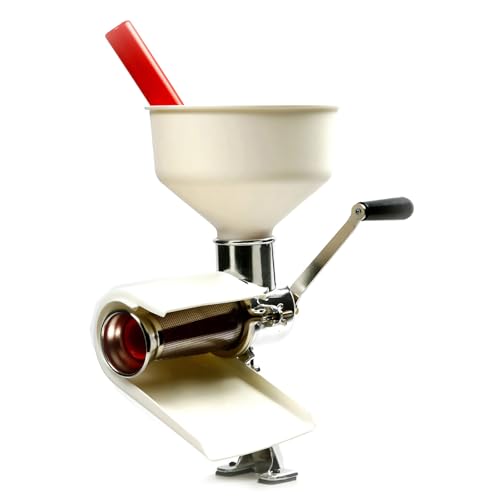
- Manual strainer for fruits, vegetables, and purees
- Listed 3-quart/95-ounce capacity
- Includes fine mesh screen and standard spiral
Best For: Modest batches of sauces, juices, and purees
High-Output Electric Choice
OMRA Spremy Electric Strainer Model 850

- Powered 1/4 HP tomato strainer
- Stated output up to 330 pounds per hour
- 220-volt corded operation
Best For: Higher-volume tomato puree production
Large-Hopper Manual Workhorse
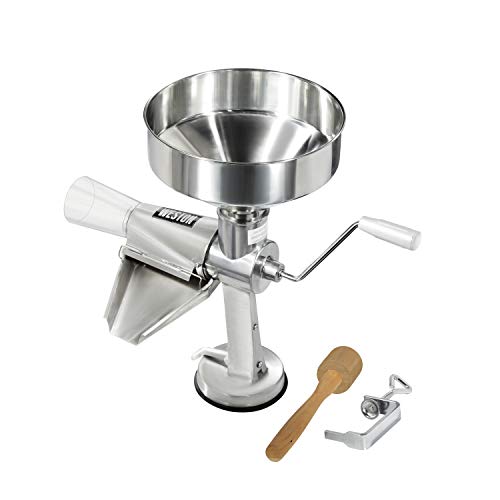
- One-gallon hopper for larger batches
- Dual suction-cup and C-clamp mounting
- Includes 1.5mm screen and stomper
Best For: Manual batch processing of tomatoes, apples, sauces, and purees
High-Volume Harvest Pick

- Separates pulp and seeds in one pass
- Large hopper supports bulk processing
- Tool-free components simplify cleanup
Best For: Small businesses processing large tomato batches
Commercial-Grade Output Pick

- Stated output reaches 200–350 lbs/h
- 304 stainless steel food-contact parts
- Wide chute supports continuous feeding
Best For: Small businesses needing high stated output
Texture-Focused Compact Pick

- Includes four screens for varied textures
- Steady DC motor supports continuous use
- Lightweight 7.2-pound design
Best For: Small operations making varied sauces and purees
High-Output Stainless Steel Pick
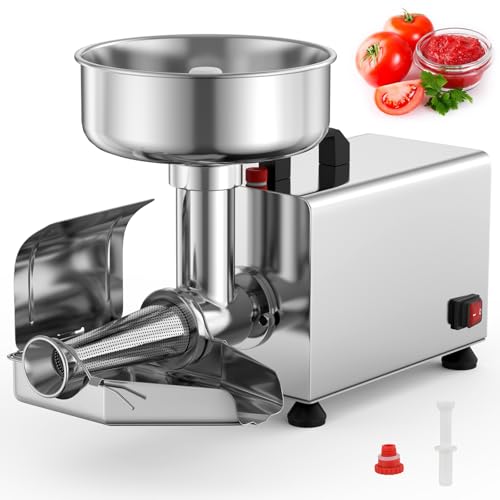
- 200–350 lb/h listed processing capacity
- 304 stainless steel body with tool-free disassembly
- Safety pusher, enclosed motor guard, and anti-slip feet
Best For: Small businesses processing large batches of sauces, jams, and fruit
Flexible Screen Selection
Weston Deluxe Electric Tomato Strainer

- Includes 1.5mm, 3mm, and 6mm screens
- Two-speed 250W motor with reverse function
- One-gallon hopper for larger batches
Best For: Businesses making sauces, purees, jellies, and varied salsa textures
Commercial-Style Processing Value

- 200–350 lb/h listed capacity with an 8.5-inch chute
- 304 stainless steel and copper construction
- 1.2mm mesh with tool-free, dishwasher-compatible cleanup
Best For: Small commercial kitchens prioritizing fast, repeatable sauce production
Versatile Manual Pick – Johnny Apple Sauce Maker Model 250
For small businesses looking for food strainer machines for small businesses, the Johnny Apple Sauce Maker Model 250 offers a flexible manual setup for separating skins and seeds from fruits and vegetables. Its clamp mount fits countertops from 3/4 to 2-1/8 inches thick, and the included 1.3mm screen is suited to fine sauces and purees.
Best For: Small-batch sauce, puree, jam, baby-food, and pie-filling production where a hand-operated machine is practical.
Pros:
- Handles produce for sauces, juices, jams, purees, soups, and more.
- Includes an apple/tomato screen, standard spiral, and instruction manual.
- Secure clamp provides 10 square inches of clamping surface.
- Optional electric motor and additional screens are available separately.
Cons:
- Hand-crank operation requires manual effort.
- Optional motor and specialty screens add extra cost.
- Clamp mounting requires a compatible countertop.
The Model 250 is a useful entry point for businesses that value versatility and compact clamp mounting over automated throughput. Its included screen supports fine processing, while the optional motor leaves room to upgrade later.
Classic 3-Quart Option – Norpro 1951 Sauce Master
The Norpro 1951 Sauce Master is a straightforward choice among food strainer machines for small businesses, using a hand-operated process to force fruits, vegetables, and purees through a chrome-plated steel screen. Its listed 3-quart capacity supports routine small-batch preparation.
Best For: Small commercial kitchens and food producers needing a basic multipurpose strainer for sauces, juices, and purees.
Pros:
- Processes vegetables, fruits, and purees in one operation.
- Includes a standard fine mesh screen and standard spiral.
- Additional berry, pumpkin, and salsa screens are available separately.
- Listed 3-quart/95-ounce capacity suits modest batches.
Cons:
- Hand operation may be slower for higher-volume production.
- Additional specialty screens require separate purchases.
- Hand-wash care is specified.
Choose the Sauce Master when a simple, multipurpose manual strainer meets your production needs. The included fine mesh screen handles general-purpose work, while optional screens can expand the machine’s applications.
High-Output Electric Choice – OMRA Spremy Electric Strainer Model 850
For businesses prioritizing speed, the OMRA Spremy Electric Tomato Strainer Model 850 stands out among food strainer machines for small businesses. Its 1/4 HP motor automatically separates tomato skins and seeds, with stated production of up to 330 pounds of tomatoes per hour.
Best For: Tomato-focused operations that need powered straining and substantially higher throughput than a hand-crank machine.
Pros:
- Automatically separates puree from tomato skins and seeds.
- Rated for production up to 330 pounds/150 kilograms per hour.
- Uses a 1/4 HP motor with cooling fan and 110 RPM worm rotation.
- Includes a stainless steel hopper and die-cast metal housing.
Cons:
- Listed for 220-volt corded operation, which may require suitable electrical service.
- Its stated uses focus on tomatoes and apples rather than a broad range of produce.
- Powered equipment can require more setup than a manual strainer.
The OMRA is the strongest fit here for volume-oriented tomato processing. Confirm that your facility supports 220 volts before choosing it, then use its automated separation and high stated capacity to reduce manual labor.
Large-Hopper Manual Workhorse – Weston Metal Tomato Strainer
The Weston Metal Tomato Strainer combines manual operation with a one-gallon hopper, making it a practical option among food strainer machines for small businesses processing larger batches without electricity. Its dual-mount system uses either suction cups or a C-clamp for flexible placement.
Best For: Batch-oriented kitchens and garden-based operations making tomato sauce, salsa, jams, preserves, or purees.
Pros:
- One-gallon hopper accommodates larger loads than many compact manual strainers.
- Stainless steel hopper, splash guard, chute, and handle support a durable setup.
- Dual suction-cup and C-clamp mounting works on various flat surfaces.
- Includes a stomper and 1.5mm multipurpose screen for tomatoes and apples.
Cons:
- Manual cranking still requires operator effort.
- Additional screens require the separately sold 07-0858 accessory kit.
- Mounting performance depends on a suitable flat surface.
Weston’s large hopper and flexible mounting make it appealing when batch size matters but an electric machine is unnecessary. The included screen covers core tomato and apple work, while the accessory kit can broaden its puree and sauce applications.
High-Volume Harvest Pick – VEVOR 370W Tomato Strainer
For small businesses seeking food strainer machines for small businesses, this 370W VEVOR model is built for frequent tomato, fruit, and vegetable processing. Its large hopper, stainless steel components, and stated capacity of up to 90 kg make it a practical option for bulk sauce, puree, juice, and canning work.
Best For: Small businesses processing large tomato batches during harvest season.
Pros:
- Separates peels and seeds in a single pass for smoother sauces and purees.
- Large hopper helps reduce frequent refills during high-volume processing.
- Stainless steel hopper, screen, tray, and guard are designed to withstand fruit acids and wear.
- Tool-free disassembly supports faster cleanup.
Cons:
- Tomatoes should be cut into small pieces to help reduce clogging.
- The 21.7-pound build may be less convenient to move frequently.
With its bulk-oriented design and easy-rinse components, this model suits operators who prioritize throughput and repeatable cleanup over portability.
Commercial-Grade Output Pick – 450W Electric Tomato Strainer
This 450W electric tomato strainer is designed for home canners and small businesses that need consistent processing for tomatoes, berries, and other soft fruits. Its stated 200–350 lbs/h output, wide feed chute, and 304 stainless steel food-contact parts support sauce, jam, juice, and canning production.
Best For: Small food businesses needing high stated output and continuous feeding.
Pros:
- 0.6 HP pure copper motor provides stated output of 200–350 lbs/h.
- 304 stainless steel food-contact components resist corrosion and help preserve clean flavors.
- Wide 8.5-inch feed chute and safety pusher support continuous feeding.
- Detachable dishwasher-safe parts and tool-free assembly simplify cleanup.
Cons:
- At 20.9 pounds, it is not the lightest option for frequent relocation.
- The supplied notes focus on sauce and jam processing rather than a broad range of firm foods.
This is the strongest fit for buyers who value a higher stated processing range, automatic operation, and features aimed at safer, less-messy batch production.
Texture-Focused Compact Pick – VEVOR 800W Max Strainer
Among food strainer machines for small businesses, this VEVOR model stands out for its four included screens and compact 7.2-pound design. It is suited to operators making tomato sauce, strawberry jam, salsa, pumpkin puree, and other products where adjustable texture matters.
Best For: Small operations that need multiple puree and sauce textures in a compact machine.
Pros:
- Four screens—1 mm, 1.5 mm, 3 mm, and 6 mm—support different textures.
- DC motor is designed for steady power, high torque, and lower noise during continuous use.
- 304 stainless steel parts resist fruit acids and wear.
- Guard cover helps reduce juice splatter, while the included brush supports cleaning.
Cons:
- The listed item highlight specifies 88 lbs/h, lower than the output stated for the other two models.
- The supplied notes list mincing as the recommended use, so buyers should confirm their intended workflow.
This model makes the most sense when recipe flexibility and easy handling are more important than maximum batch throughput.
High-Output Stainless Steel Pick – COSTWAY 450W Tomato Strainer
For small businesses seeking food strainer machines for small businesses, the COSTWAY 450W model emphasizes throughput and durable construction. Its listed capacity is 200–350 pounds per hour, making it suited to commercial-style batches of sauces, jams, and fruit preparations.
Best For: Small food businesses processing large batches of tomatoes, berries, pineapples, or other soft fruit.
Pros:
- 450W copper motor and 8.5-inch feed chute support high-volume processing.
- Food-grade 304 stainless steel construction is durable and easy to sanitize.
- Tool-free disassembly and dishwasher-safe detachable parts simplify cleanup.
- Safety pusher, enclosed motor guard, waterproof switch, and anti-slip feet add practical safeguards.
Cons:
- At 22 pounds and 20.5 inches deep, it needs dedicated counter or storage space.
- The supplied details specify hand-wash care, while detachable parts are also described as dishwasher-safe; confirm the preferred cleaning method in the manual.
The COSTWAY is the strongest fit here when output is the priority. Its commercial-oriented build and broad fruit-processing range can help a small operation move through preservation batches efficiently, provided the available workspace and electrical setup accommodate its 110–120V design.
Flexible Screen Selection – Weston Deluxe Electric Tomato Strainer
Among food strainer machines for small businesses, the Weston Deluxe stands out for adaptable texture control rather than a stated commercial throughput figure. Its one-gallon hopper, two-speed 250W motor, and three screens support sauces, purees, jellies, and salsa.
Best For: Small businesses that need to switch between smooth sauces, purees, and chunkier preparations.
Pros:
- Three stainless steel screens—1.5mm, 3mm, and 6mm—offer multiple texture options.
- Two speeds include reverse operation to help prevent jamming.
- One-gallon hopper accommodates larger batches without constant refilling.
- Includes a stomper for feeding produce safely into the hopper.
Cons:
- The 250W motor has a lower listed wattage than the 450W alternatives.
- Its plastic and stainless steel construction may feel less heavy-duty than an all-stainless commercial machine.
- No processing rate is provided in the supplied details, so real output may require evaluation for higher-volume work.
The Weston is a practical choice when product variety matters more than maximum stated throughput. The included screens make it easier to tailor textures, while reverse operation and the large hopper add useful convenience for recurring preservation work.
Commercial-Style Processing Value – 450W Stainless Tomato Press
This 450W tomato press is aimed at small businesses that need food strainer machines for small businesses with a high listed processing rate. It is specified to handle 200–350 pounds per hour and uses 304 stainless steel components for repeated sauce and preserve preparation.
Best For: Small commercial kitchens and preserve makers prioritizing speed, stainless construction, and straightforward cleanup.
Pros:
- Listed 200–350 lb/h capacity and 8.5-inch feed chute support substantial batches.
- Food-grade 304 stainless steel and copper construction are suited to demanding use.
- Tool-free disassembly and dishwasher-compatible detachable parts help reduce cleanup time.
- Safety features include an enclosed motor guard, insulated waterproof switch, pusher, and anti-slip feet.
Cons:
- The 22-pound unit and 20.5-inch length require meaningful counter or storage space.
- The supplied specifications list a 1.2mm mesh opening, offering less documented texture flexibility than models with multiple screens.
- The notes do not identify a warranty or additional mesh options.
This model is a sensible match for operations that value fast, repeatable tomato and fruit processing. Its single listed mesh and commercial-style output make it less focused on texture experimentation, but the stainless build and cleaning design support routine batch work.
How We Picked the Best Food Strainer Machines for Small Businesses
We focused on the practical demands of small commercial kitchens, farm stands, caterers, specialty food producers, and growing home-based businesses. The comparison considers drive type, motor power, stated processing capacity, hopper and body materials, cleanup, portability, and the kinds of foods each machine can handle.
Manual models can be sensible for occasional or low-volume work, while electric machines are generally better suited to repeated batches. Because advertised capacity can vary with produce type, preparation, and operating conditions, treat throughput ratings as useful benchmarks rather than guaranteed results.
Quick Comparison
- Best for occasional batches: Clamp-on or hand-operated strainers offer simple operation and minimal electrical requirements.
- Best for regular small-batch production: Midrange electric models provide faster processing without requiring the footprint of larger commercial equipment.
- Best for higher volume: Heavy-duty electric machines with stainless-steel components and large hoppers can reduce processing time when used continuously.
- Best for flexibility: Look for interchangeable screens or compatible accessories if you plan to process tomatoes, berries, apples, or other soft produce.
Key Buying Factors for Food Strainer Machines for Small Businesses
Capacity and Throughput
Estimate how many pounds of produce you process per batch and per day. A machine that is too small can create bottlenecks, but an oversized unit may cost more, occupy valuable workspace, and be inefficient for occasional use.
Manual or Electric Operation
Manual strainers are quiet, portable, and straightforward, but they require more physical effort. Electric models are preferable for repetitive production, especially when multiple batches must be processed during a short service or preservation window.
Construction and Food Contact Materials
Stainless steel is valued for durability, corrosion resistance, and easier sanitation. Check whether the hopper, screen, auger, and other food-contact parts are removable and whether replacement screens or wear parts are available.
Produce Preparation and Separation
Confirm whether the machine is intended to remove skins, seeds, pits, or pulp from the foods you use. Some models perform best with cooked or softened produce, so preparation requirements should fit your recipes and workflow.
Cleaning, Safety, and Support
Prioritize accessible parts, stable mounting or feet, overload protection where available, and clear operating instructions. Before buying, verify voltage, plug requirements, warranty coverage, and the availability of replacement components.
Who Should Buy Which Food Strainer Machines for Small Businesses?
Choose a manual model if you process small quantities, need portability, or want the simplest setup. Choose a midrange electric strainer for recurring sauce, puree, or jam production where labor savings matter. Choose a higher-capacity commercial-style machine if your business regularly handles large harvests, wholesale orders, or several production batches in succession.
For most buyers, the best Food Strainer Machines for Small Businesses are not necessarily the most powerful models. Select the unit that comfortably handles your normal workload, fits your available counter or prep space, and can be cleaned and serviced without disrupting production.