Making fresh juice for a café, restaurant, event, or busy household requires more than a standard handheld squeezer. The right citrus juicer can improve speed, yield, consistency, and cleanup while reducing the effort required for every orange, lemon, lime, or grapefruit.
These 10 picks include high-capacity electric machines and heavy-duty manual presses, with options for different budgets, workloads, and space constraints. Use the guide below to match the juicer’s design and capacity to your typical batch size.
Best 10 Citrus Juicers for Large Batches Picks for 2026
Heavy-Duty Manual Pick

- Cast-iron body for repeated use
- Lever-assisted manual extraction
- Dishwasher-safe removable parts
Best For: Countertop users wanting a sturdy manual press
Fast Electric Option

- Rated for up to 120 oranges per hour
- Universal reamer for varied citrus
- Compact, stable die-cast base
Best For: Bars and small commercial spaces needing powered output
Large-Volume Manual Pick
Jupiter Commercial Juice Press

- Cast-iron commercial construction
- Designed for large quantities
- Ergonomic handle and stainless strainer
Best For: Extended manual juicing in commercial-style settings
Commercial Rack-and-Pinion Pick

- Rack-and-pinion pressing system
- Removable strainer cone
- NSF-listed commercial design
Best For: Restaurants and cafés needing durable manual extraction
Commercial Workhorse
YUANHAO Electric Citrus Juicer
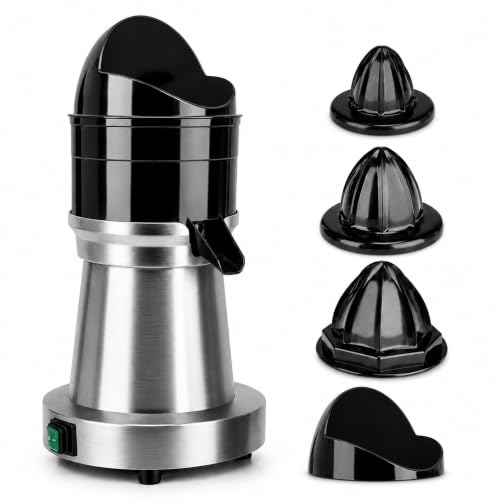
- Designed for fast, continuous citrus juicing
- Includes three interchangeable reamers
- Dishwasher-safe removable parts
Best For: Busy juice bars, restaurants, cafes, and high-volume home use
Flexible Countertop Pick
Cuisinart Pulp Control Citrus Juicer

- Three adjustable pulp-control settings
- Handles limes through grapefruits
- Auto-reversing cone and final-spin feature
Best For: Home kitchens and moderate serving runs with customizable pulp
Quiet Commercial Performer
Hamilton Beach FreshMark Juicer
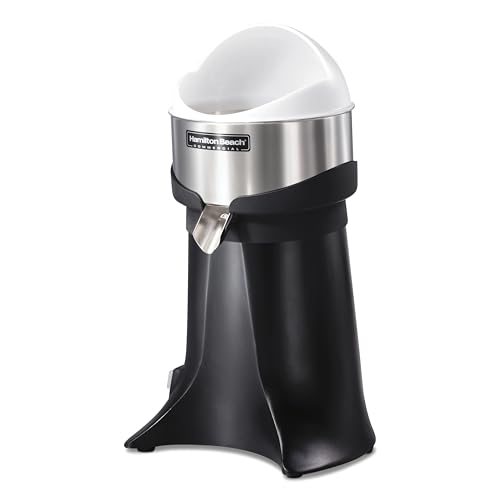
- Fills a glass in less than 30 seconds
- Quiet brushless induction motor
- Tall spout fits glasses and pitchers
Best For: Commercial service areas needing fast, quiet, heavy-duty juicing
Best with Extra Features

- Heavy-duty cast iron construction
- 5-inch bowl for varied citrus sizes
- Strong lever with stable rubberized feet
Best For: Home users, bartenders, juice stands, and busy kitchens
Commercial Manual Classic
Hamilton Beach 932 Citrus Juicer

- Up to 2,000 pounds of pressing force
- Acid-resistant metal and enamel finish
- NSF certified with Sure Grip feet
Best For: Bars, restaurants, and commercial food-service use
Highest-Volume Electric Option
VEVOR Commercial Orange Juicer

- Processes up to 20 oranges per minute
- Automatic peeling, juicing, and filtering
- Detachable parts aid commercial cleanup
Best For: High-volume commercial citrus service
Heavy-Duty Manual Pick – Eurolux Cast Iron Press
For citrus juicers for large batches, the Eurolux is a sturdy manual option built for repeated countertop use. Its cast-iron body, lever-assisted pressing action, 15-ounce cup, and removable fruit-contact parts make it practical for fresh orange, lemon, lime, or pomegranate juice without relying on electricity.
Best For: Home users and small-scale juice makers who want a heavy-duty manual press with a built-in collection cup.
Pros:
- Heavy-duty cast-iron construction is designed for continuous juicing.
- Lever action helps reduce effort during pressing.
- Removable fruit-contact parts are dishwasher safe.
- Suction-cup feet help stabilize the juicer on the counter.
Cons:
- Manual operation requires repeated physical effort for very large runs.
- The 15-ounce cup may need frequent emptying during batch juicing.
- Its heavy construction makes it less convenient to move regularly.
The Eurolux balances commercial-style construction with straightforward countertop operation. It is a strong choice when durability and leverage matter more than electric speed.
Fast Electric Option – Waring Compact Citrus Juicer
Among citrus juicers for large batches, the Waring Compact Electric Citrus Juicer stands out for its stated capacity of up to 120 oranges per hour. Its compact footprint, universal reamer, and stable die-cast base make it suitable for bars, restaurants, or other spaces where powered throughput is useful.
Best For: Small commercial workspaces that need electric citrus juicing in a compact format.
Pros:
- Rated to juice up to 120 oranges per hour.
- Universal reamer handles different types of citrus fruit.
- Compact 7.25-inch square footprint suits tighter counters.
- Vibration-dampening feet support quiet, stable operation.
Cons:
- Its one-quart capacity may require frequent emptying during extended batches.
- Only one speed is listed.
- Electric operation requires access to a 120-volt outlet.
The Waring is the most throughput-focused choice in this group. Choose it when powered operation and a small footprint are more important than the flexibility of a manual press.
Large-Volume Manual Pick – Jupiter Commercial Juice Press
For citrus juicers for large batches, the Focus Foodservice Jupiter is designed around high-volume manual pressing. Its cast-iron construction, ergonomic rubber-grip handle, and 18-8 stainless steel perforated strainer are intended to deliver substantial extraction with minimal effort.
Best For: Commercial kitchens, juice counters, and users who need a robust manual press for extended citrus-juicing sessions.
Pros:
- Cast-iron construction is built for long-lasting commercial use.
- Designed to generate large quantities with minimal effort.
- Rubberized handle provides a secure grip and cushioned stop.
- Stainless steel perforated strainer helps separate juice from solids.
Cons:
- Hand washing is required according to the care instructions.
- Manual pressing is slower than powered equipment for some workflows.
- The supplied notes do not specify a countertop stabilizing mechanism.
The Jupiter is a purpose-built manual press for demanding use. Its seven-year warranty and durable materials add confidence for buyers prioritizing longevity over automation.
Commercial Rack-and-Pinion Pick – Nemco Manual Citrus Juicer
The Nemco 55850 is a commercial-style manual choice among citrus juicers for large batches. Its stainless steel rack-and-pinion system, removable strainer cone, ergonomic handle, and NSF listing emphasize consistent pressing, maintenance access, and suitability for demanding restaurant or café use.
Best For: Restaurants, cafés, juice bars, and home users who want a heavy-duty manual juicer with a geared pressing mechanism.
Pros:
- Rack-and-pinion design is intended to provide uniform pressing pressure.
- Aluminum and stainless steel construction supports heavy-duty use.
- Removable strainer cone simplifies cleaning and maintenance.
- NSF listing supports use in foodservice environments.
Cons:
- Hand washing is required according to the care instructions.
- At 19 inches deep, it may need substantial counter space.
- Manual operation can be demanding during exceptionally large batches.
The Nemco combines a geared mechanism with commercial-grade materials and serviceability. It is a sensible fit when consistent manual extraction and foodservice-oriented construction are key priorities.
Commercial Workhorse – YUANHAO Electric Citrus Juicer
For citrus juicers for large batches, the YUANHAO is designed around fast, continuous operation. Its 160-watt motor, stainless steel construction, and three interchangeable reamers make it a practical choice for processing oranges, lemons, limes, and grapefruits in busy settings.
Best For: Juice bars, restaurants, cafes, and home users who need a compact commercial-style machine.
Pros:
- Built for high-volume, continuous citrus juicing.
- Three reamers accommodate different fruit sizes.
- Splash guard and pulp filter help contain mess and seeds.
- Removable parts, including the reamers and drip tray, are dishwasher safe.
Cons:
- Its 16.93-inch height may require adequate vertical clearance.
- The 5 kg construction is less lightweight than a basic countertop juicer.
The YUANHAO combines commercial-oriented durability with straightforward one-button operation. It is especially appealing when throughput and cleanup matter more than a minimalist footprint.
Flexible Countertop Pick – Cuisinart Pulp Control Citrus Juicer
The Cuisinart CCJ-500P1 is a versatile option for citrus juicers for large batches when adjustable pulp and fruit-size flexibility are priorities. Its universal cone handles limes through grapefruits, while the auto-reversing action and final-spin feature help make the most of each fruit.
Best For: Home kitchens and smaller serving runs where customizable pulp control is important.
Pros:
- Three pulp-control settings offer low, medium, and high options.
- Accommodates small limes and large grapefruits.
- Auto-reversing cone and final-spin feature support efficient extraction.
- Dishwasher-safe parts simplify cleanup.
Cons:
- Its 12-ounce capacity is less suited to uninterrupted commercial-scale output.
- The compact design is geared more toward countertop use than heavy-duty service.
This Cuisinart is a sensible choice for users who want control over pulp and a machine that can handle varied citrus sizes. The three-year limited warranty adds useful ownership support.
Quiet Commercial Performer – Hamilton Beach FreshMark Juicer
For citrus juicers for large batches in customer-facing environments, the Hamilton Beach FreshMark HCJ967R emphasizes speed, quiet operation, and durability. Its brushless induction motor, three reinforced reamers, and extra-tall open spout are suited to filling glasses, pitchers, or storage containers efficiently.
Best For: Commercial kitchens, juice bars, cafes, and service counters that need quiet, high-throughput juicing.
Pros:
- Designed to fill a glass of juice in less than 30 seconds.
- Virtually silent brushless induction motor supports a quieter service area.
- Three reinforced reamers cover lemons, limes, oranges, and grapefruits.
- Extra-tall 8.5-inch spout accommodates glasses and larger containers.
Cons:
- At 28.1 pounds, it is substantially heavier than compact countertop models.
- Its 18.11-inch height and commercial construction require more counter space.
The FreshMark is the strongest fit here for professional throughput and quiet operation. Its low-center-of-gravity base, sealed switch, and removable bowl components also support stable, practical daily use.
Best with Extra Features – Zulay Cast Iron Citrus Press
For citrus juicers for large batches, the Zulay Kitchen Cast Iron Juicer is a strong manual option. Its 5-inch bowl accommodates limes, lemons, oranges, and grapefruits, while the lever design is built to extract juice quickly without electricity.
Best For: Home users, bartenders, juice stands, and busy kitchens that want a durable manual press.
Pros:
- Heavy-duty cast iron construction supports continuous, high-pressure use.
- Lever arm provides strong mechanical advantage with minimal effort.
- 5-inch bowl handles a broad range of citrus sizes.
- Rubberized feet help keep the press stable during use.
Cons:
- At 15.1 pounds, it is relatively heavy to move and store.
- Hand-wash-only care requires manual cleanup.
- Manual pressing requires handling fruit one piece at a time.
This is a practical choice when durability and juice yield matter more than automation. Its sturdy build suits repeated batch work, though an electric machine may be faster for very high-volume service.
Commercial Manual Classic – Hamilton Beach 932 Citrus Juicer
The Hamilton Beach Commercial 932 is designed for citrus juicers for large batches when consistent manual extraction and commercial durability are priorities. Its extractor arm applies up to 2,000 pounds of force, and the removable strainer cone and funnel simplify cleaning.
Best For: Bars, restaurants, and food-service settings needing a certified commercial manual citrus press.
Pros:
- Extractor arm delivers up to 2,000 pounds of force.
- Metal components and enamel finish resist citrus-acid wear.
- Sure Grip feet help prevent tipping during pressing.
- NSF certified for food-service equipment standards.
Cons:
- Its 8-fluid-ounce capacity is smaller than a continuous electric juicer setup.
- Hand-wash-only care adds cleanup time.
- Manual operation requires individual fruit preparation and pressing.
The 932 is a dependable commercial-style press for controlled batches of lemons, limes, oranges, and grapefruits. It is especially appealing when sanitation features, stability, and long-term wear resistance are more important than fully automated throughput.
Highest-Volume Electric Option – VEVOR Commercial Orange Juicer
For citrus juicers for large batches, the VEVOR Commercial Orange Juicer is the most automated option in this group. Its 120-watt motor combines peeling, juicing, and filtering, with a stated capacity of up to 20 oranges per minute.
Best For: Grocery stores, restaurants, fruit shops, bars, beverage shops, and other commercial locations handling high volumes.
Pros:
- Processes up to 20 oranges per minute.
- Automatic peeling, juicing, and filtering reduce manual labor.
- Accommodates fruit measuring about 2.2 to 3.2 inches in diameter.
- Detachable parts and a pull-out filter box support thorough cleaning.
Cons:
- At 81.4 pounds, it is difficult to move once installed.
- Its 25.59-inch width and 30.71-inch height require substantial counter or floor space.
- Hand-wash-only care still requires hands-on cleaning.
This machine is the strongest fit for high-throughput commercial service, particularly when minimizing repetitive manual pressing is important. Its large footprint and weight make it less suitable for a compact home kitchen.
How We Picked the Best Citrus Juicers for Large Batches
We focused on juicers designed to handle repeated use rather than occasional single servings. Key considerations included operating speed, pressing force, construction, fruit compatibility, juice yield, stability, cleanup, and the amount of manual effort required.
The selection includes commercial electric models for speed, crank and lever presses for quiet operation and control, and compact countertop machines for households or smaller service areas. Features such as removable strainers, pulp controls, acid-resistant finishes, sturdy bases, and stainless steel components were also weighed because they affect daily usability and longevity.
Quick Comparison
| Type | Best For | Main Advantage | Potential Trade-Off |
|---|---|---|---|
| Commercial electric | Cafés, bars, restaurants, and events | Fast, consistent output | Higher cost, noise, and cleaning needs |
| Manual lever press | Moderate batches and juice bars | Strong extraction without electricity | Requires physical effort |
| Manual crank press | Controlled, repeatable pressing | Good leverage and quiet operation | Slower than electric models |
| Compact countertop electric | Homes and light-duty service | Small footprint and simple operation | Lower sustained capacity |
Key Buying Factors for Citrus Juicers for Large Batches
Capacity and Speed
Check the stated output per hour or minute, but remember that real throughput also depends on fruit size, loading time, and how often the machine needs cleaning. For continuous service, choose a commercial electric model with enough capacity to avoid bottlenecks.
Manual Effort and Extraction Design
Lever presses use mechanical advantage to extract juice with relatively little force, while crank models provide controlled operation. These are useful when noise, power access, or maintenance is a concern. Electric machines are better when staff need to produce many servings quickly.
Fruit Compatibility and Yield
Make sure the cone or feed system accommodates the fruit you use most. Small limes, standard lemons, oranges, and large grapefruits may require different cone sizes or pressing clearances. A well-designed strainer can also help manage pulp and seeds without slowing service.
Construction and Cleanup
Heavy cast iron and commercial metal components improve stability during repeated pressing. Look for removable cones and strainers, corrosion-resistant surfaces, accessible parts, and a design that does not trap pulp around the motor or frame. A stable base or non-slip feet are especially important for manual presses.
Who Should Buy Which Citrus Juicers for Large Batches?
Choose a commercial electric juicer if you run a busy café, restaurant, bar, catering operation, or event station where speed is the priority. These models are the strongest fit for sustained high-volume production.
Choose a heavy-duty manual press if you want excellent leverage, dependable construction, and no motor to maintain. Manual models suit cocktail programs, home juice enthusiasts, farm stands, and moderate batches.
Choose a compact electric model if you mainly juice at home or need a smaller machine for occasional service. It offers easier operation than a manual press without taking up the space or demanding the investment of a full commercial unit.