Making evenly rolled dough is easier when your equipment matches the size of the job. The best dough sheeters for small batches offer practical thickness control, compact storage, and enough working space for pastries, pizza, cookies, and pasta without requiring a full commercial setup.
We’ve gathered 10 manual sheeters, rolling machines, rolling pins, and accessory sets to help home bakers choose the right balance of precision, portability, cleanup, and value.
Best 10 Dough Sheeters for Small Batches Picks for 2026
Most Versatile
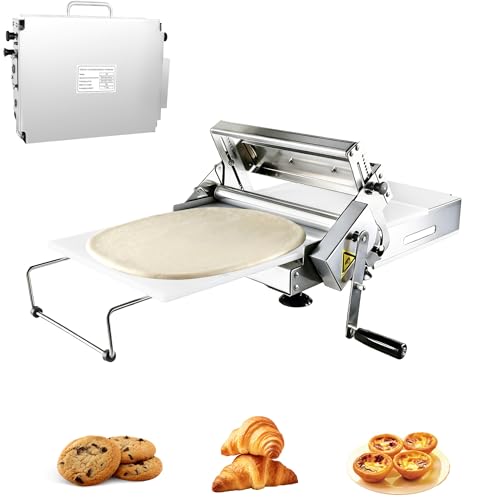
- 0.2-27mm thickness adjustment
- Foldable stainless-steel design
- Food-grade, easy-clean rolling board
Best For: Varied small-batch doughs and pastries
Best Budget Alternative
Norpro Wood Pastry/Pizza Roller

- Two roller sizes for dough and pan edges
- Compact 7.25-inch design
- Also crushes nuts, crackers, and crumbs
Best For: Occasional small-batch pies and pizza
Best Stability
Compact Dual-Board Dough Sheeter
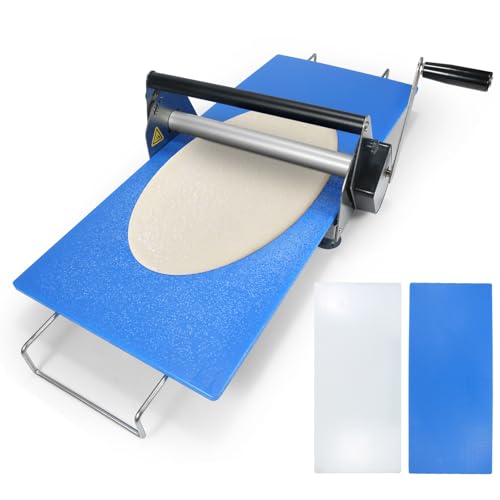
- Non-slip base and stainless-steel frame
- Two 27.5-by-12-inch PE boards
- Locking 0-17.5mm thickness slots
Best For: Stable, repeatable small-batch rolling
Best Manual Control
Stainless Steel Rolling Pin Set

- Four thickness rings from 2-10mm
- Food-grade 304 stainless steel
- Includes a 23.6-by-15.7-inch mat
Best For: Very small batches and beginner baking
Best Adjustable Sheeter

- 56 stated thickness settings across a 0–25 mm range
- Foldable 40.6 × 22.8-inch work platform
- Manual, stainless-steel construction for versatile baking
Best For: Home bakers and small bakeries needing adjustable thickness control
Best Compact Option

- Compact 7.48-inch wooden rolling pin
- Smoothly polished surface with ergonomic handle
- Works for cookies, pizza, pies, dumplings, and more
Best For: Occasional home baking and very small batches
Best Easy-Clean Sheeter
Stainless Steel Manual Dough Roller

- Foldable design supports compact storage
- 304 stainless steel construction is easy to clean
- Adjustable 2–30 mm thickness range
Best For: Space-conscious home bakers wanting a versatile manual machine
Compact Hand Roller

- Wood construction with a stainless steel connecting shaft
- Comfortable handled design for quick manual rolling
- Suitable for pizza, pastries, dumplings, tortillas, and crafts
Best For: Small-batch home baking and versatile dough shaping
Foldable Precision Sheeter

- 0.2–27 mm adjustable thickness range
- Non-stick food-grade PE rolling board
- Folds for storage in compact kitchens
Best For: Home bakers and small commercial spaces needing adjustable thickness
Stainless Steel Crank Sheeter

- 12-inch roller for pizza, pastry, and wrappers
- 0.2–27 mm thickness adjustment
- 304 stainless steel body with ergonomic hand crank
Best For: Home bakers and small bakeries seeking versatile manual sheeting
Most Versatile – HESMAX Folding Dough Sheeter
For bakers comparing dough sheeters for small batches, the HESMAX offers broad thickness adjustment, a roomy rolling surface, and a foldable stainless-steel design. Its manual operation suits home kitchens and small commercial baking setups handling croissants, pizza, pastries, pasta, and more.
Best For: Bakers who want a foldable sheeter with an especially wide thickness range for varied dough projects.
Pros:
- Adjusts from 0.2 to 27mm for laminated doughs, pizza, cookies, pasta, fondant, and gum paste.
- Food-grade PE rolling board and stainless-steel body are designed for regular food preparation.
- Foldable construction reduces the storage footprint from its unfolded size.
- Integrated, non-stick rolling boards have no dead corners and are easy to clean.
Cons:
- At 33 inches deep when unfolded, it needs substantial counter space during use.
- Manual operation requires hands-on effort for each batch.
The HESMAX is a strong choice when flexibility matters more than compact countertop dimensions. Its wide adjustment range and folding frame make it practical for varied small-batch baking, provided you have room to set it up.
Best Budget Alternative – Norpro Wood Pastry/Pizza Roller
Although it is a hand roller rather than a machine, the Norpro is a useful compact option for anyone seeking dough sheeters for small batches without dedicating counter space to larger equipment. Its two roller sizes cover general dough rolling and pan-edge finishing.
Best For: Home bakers making occasional pies, cookies, or pizza who prefer a lightweight manual tool.
Pros:
- Large 4.125-inch roller helps create a more uniform crust.
- Small 2.5-inch roller reaches pan edges and smooths sides.
- Compact 7.25-inch length and 3.2-ounce weight make it easy to store.
- Can also crush nuts, crackers, cookies, and bread crumbs.
Cons:
- It does not provide adjustable thickness settings.
- The narrow roller is less suited to large sheets or frequent high-volume work.
The Norpro is best viewed as a simple, space-saving alternative to a true sheeter. It is convenient for small portions and pan work, but bakers needing precise, repeatable thickness should consider an adjustable model instead.
Best Stability – Compact Dual-Board Dough Sheeter
This compact manual machine is a practical pick among dough sheeters for small batches, combining a stainless-steel frame, non-slip base, foldable construction, and two rolling boards. Clearly marked thickness slots make repeatable rolling more straightforward for home bakers and small bakeries.
Best For: Small-batch bakers who value stable setup, two board surfaces, and defined thickness positions.
Pros:
- Non-slip base is designed to improve stability during manual rolling.
- Two 27.5-by-12-inch PE boards provide rough and smooth surfaces for different doughs.
- Thickness slots adjust from 0 to 17.5mm and lock into position.
- Detachable stainless-steel parts and wipe-clean boards simplify cleanup.
Cons:
- Its 17.96-pound weight makes it less convenient to move frequently.
- The maximum thickness range is narrower than the HESMAX model’s.
With its dual boards and secure thickness settings, this model emphasizes consistency and cleanup rather than maximum adjustment range. The folding frame helps with storage, though its substantial weight favors a semi-permanent baking station.
Best Manual Control – Stainless Steel Rolling Pin Set
For very small batches, this rolling pin and mat set offers a simpler alternative to dough sheeters for small batches. The stainless-steel pin uses removable thickness rings to guide rolling at four preset depths, while the included mat provides a defined work surface.
Best For: Beginners and home bakers who want a compact, hands-on tool for dough, pastry, pizza, pasta, and cookies.
Pros:
- Four rings guide thicknesses of 2, 4, 6, and 10mm.
- Food-grade 304 stainless steel is designed to resist rust, sticking, and cracking.
- The 17-inch pin and 23.6-by-15.7-inch mat suit a range of home baking tasks.
- Removing the rings converts it to a straight rolling pin.
Cons:
- Preset rings offer less thickness flexibility than a machine with continuous adjustment.
- Manual rolling can be more labor-intensive for repeated batches.
This set is the most compact and approachable option in the group. It works well when batches are modest and storage space is limited, but it will not match a dedicated sheeter for speed or broad thickness control.
Best Adjustable Sheeter – Foldable Manual Dough Sheeter
For bakers comparing dough sheeters for small batches, this manual model offers fine thickness control without requiring electricity. Its foldable platform provides a generous work area when open while helping conserve storage space between baking sessions.
Best For: Home bakers, food trucks, and small bakeries making pizza, pastry, pasta, dumpling wrappers, or fondant.
Pros:
- Offers a stated 0–25 mm range with 56 adjustable settings for controlled thickness.
- Stainless steel contact surface and reinforced alloy frame support frequent use.
- Large 40.6 × 22.8-inch platform folds for more convenient storage.
- Manual 360-degree handle works without electricity.
Cons:
- At 24 pounds, it is heavier than a basic rolling pin.
- The large working platform requires substantial counter space when unfolded.
This is the most feature-rich option here for users who want repeatable thickness adjustments and a larger sheeting surface, provided they have room to set it up.
Best Compact Option – Small Wooden Dough Roller
If your dough sheeters for small batches search is focused on minimal storage and simple handling, this compact wooden rolling pin is a practical alternative to a machine-style sheeter. It is suited to small quantities that can be rolled by hand.
Best For: Home cooks and occasional bakers making cookies, pizza, pies, dumplings, tortillas, noodles, or similar doughs.
Pros:
- Compact 7.48-inch-long design is easy to store in a small kitchen.
- Natural wood construction with a smoothly polished surface.
- Ergonomic handle design is intended to make rolling more comfortable.
- Can be used for a broad range of doughs and baking projects.
Cons:
- It does not provide the mechanical thickness control of a dedicated sheeter.
- Its small size is better suited to small batches than large dough sheets.
This is the simplest and most space-conscious choice for light home baking, but users seeking highly uniform sheets or higher throughput should consider a full-size manual sheeter instead.
Best Easy-Clean Sheeter – Stainless Steel Manual Dough Roller
Among dough sheeters for small batches, this foldable stainless steel machine balances a broad working surface with manual crank operation. Its adjustable 2–30 mm range is useful when you want different thicknesses for pizza, croissants, egg tarts, and other rolled pastries.
Best For: Home bakers with limited kitchen space who want a manually operated sheeter with multiple thickness settings.
Pros:
- Folds into a compact, suitcase-like form for storage.
- Hand crank is designed to roll dough evenly with less effort than hand rolling.
- Food-grade 304 stainless steel is described as hygienic and easy to clean.
- Adjustable gears cover a stated 2–30 mm thickness range.
Cons:
- The 40.5 × 22.8-inch format still needs considerable space during use.
- At 22.4 pounds, it is not especially lightweight to move frequently.
This model is a strong fit when foldaway storage and easy cleanup matter as much as adjustable thickness, though its full-size footprint is worth measuring before purchase.
Compact Hand Roller – Small Wooden Dough Roller
If you only need dough sheeters for small batches, this compact wooden roller is a straightforward option for shaping dough around pans and creating evenly thick crusts. Its handheld design suits quick baking tasks without requiring a countertop machine.
Best For: Home bakers making small portions of pizza, cookies, pies, tortillas, dumplings, fondant, or similar doughs.
Pros:
- Wooden roller with a sturdy stainless steel connecting shaft.
- Handle design is comfortable to hold and easy to carry or store.
- Useful for smoothing edges and sides and creating more uniform dough thickness.
- Works with a broad range of baking, cooking, and craft applications.
Cons:
- Requires manual rolling and does not offer a calibrated thickness adjustment.
- Package includes only one roller.
- Its compact format may be less suitable for large sheets of dough.
This is best viewed as a simple, space-conscious tool rather than a full machine-style sheeter. Choose it when portability, versatility, and small-batch preparation matter more than precise mechanical thickness control.
Foldable Precision Sheeter – 12-Inch Manual Dough Sheeter
For dough sheeters for small batches that need more consistent thickness, this 12-inch manual model combines a broad adjustment range with a foldable footprint. It is designed to support home kitchens, small bakeries, cafés, and other spaces where storage matters.
Best For: Bakers who want adjustable thickness for laminated doughs, pasta, pizza, cookies, fondant, and other preparations without using an electric machine.
Pros:
- Adjusts from 0.2 to 27 mm for thin wrappers through thicker doughs.
- Integrated food-grade PE non-stick rolling board is designed for easier release and cleanup.
- Stainless steel construction provides a sturdy, rust-resistant body.
- Folds for more compact storage; the folded size is listed as 10.4 × 13.7 × 4.4 inches.
Cons:
- Manual operation still requires physical effort.
- Its 12-inch rolling width may not suit especially large dough sheets.
- The unfolded unit requires substantial counter space.
The main advantage here is control: the wide thickness range makes recipe-specific results easier to repeat than with a basic rolling pin. Its folding frame also makes it a practical fit for kitchens that cannot leave equipment on the counter.
Stainless Steel Crank Sheeter – 12-Inch Folding Dough Roller
This 12-inch machine is a strong candidate among dough sheeters for small batches when you want repeatable thickness and a hand-crank format. Its folding structure helps conserve space, while the wide roller is suited to common pastry and wrapper preparations.
Best For: Home bakers and small bakeries preparing pizza crusts, dumpling wrappers, croissants, egg tarts, and puff pastry.
Pros:
- 12-inch roller accommodates a variety of dough sizes.
- Thickness adjusts from 0.2 to 27 mm using a control knob.
- 304 stainless steel construction is rust-resistant, non-toxic, and easy to clean.
- Ergonomic hand crank is designed to reduce wrist and arm fatigue.
Cons:
- Manual cranking requires user effort.
- At 17.71 pounds, it is less lightweight than a simple rolling pin.
- Its 12-inch width may be limiting for oversized dough sheets.
This model offers a useful balance of working width, thickness control, and storage flexibility. It makes the most sense for bakers who regularly prepare several types of dough but still prefer a manually operated machine.
How We Picked the Best Dough Sheeters for Small Batches
We focused on equipment suited to home kitchens, occasional baking, and lower-volume preparation rather than high-output commercial production. Our comparison considers rolling width, thickness adjustment, construction materials, portability, storage, ease of cleaning, and the types of dough each design can handle.
Because the selection includes both dedicated dough sheeters and simpler rolling tools, we also considered how much consistency and capacity each option provides. A manual machine may offer more uniform thickness, while a rolling pin can be more affordable and easier to store.
Quick Comparison
| Type | Best For | Main Advantage | Potential Limitation |
|---|---|---|---|
| Folding manual sheeter | Pastry, pizza, cookies | Adjustable thickness and compact storage | Requires hand operation and counter space |
| Large manual sheeter | Wider pizza and pastry dough | More working area | Heavier and harder to store |
| Adjustable rolling-pin set | Flexible home baking | Thickness rings and useful accessories | Less automated than a machine |
| Traditional rolling pin | Small portions and quick tasks | Low cost and simple cleanup | Thickness depends more on technique |
Key Buying Factors for Dough Sheeters for Small Batches
Width and Batch Size
Measure your counter and consider the dough you make most often. A 12-inch roller is generally practical for home pastry and moderate pizza dough, while wider machines are better for larger rounds but need more storage space.
Thickness Control
Adjustable settings help reproduce results for laminated pastry, cookies, noodles, and pizza. Look for clearly marked settings or a dependable adjustment mechanism. If you mainly make rustic dough, a standard rolling pin may be sufficient.
Materials and Stability
Stainless steel components are usually easy to wipe clean and resist corrosion, while wood and nonstick surfaces can feel comfortable for occasional use. Check whether the machine has a stable base, secure feet, or a board that will not shift during rolling.
Storage and Cleanup
Folding models are useful when cabinet space is limited. Removable boards, smooth surfaces, and minimal seams can make cleanup easier, especially after working with sticky or buttery dough.
Who Should Buy Which Dough Sheeters for Small Batches?
Choose a folding manual sheeter if you want repeatable thickness with a compact footprint. It is a strong fit for home bakers who regularly make pastry, pasta, cookies, or pizza in modest quantities. Select a wider manual machine if you frequently prepare larger dough sheets and have dedicated counter or storage space.
An adjustable rolling-pin set suits shoppers who want versatility without committing to a full machine. It can handle several dough types while remaining relatively easy to store. A small wooden rolling pin is the simplest choice for occasional baking, small portions, and shoppers who prioritize low cost over precise, repeatable thickness.
Before buying, confirm the product’s dimensions, adjustment range, included board or mat, and cleaning instructions. The best option is the one that fits both your recipes and your available workspace.